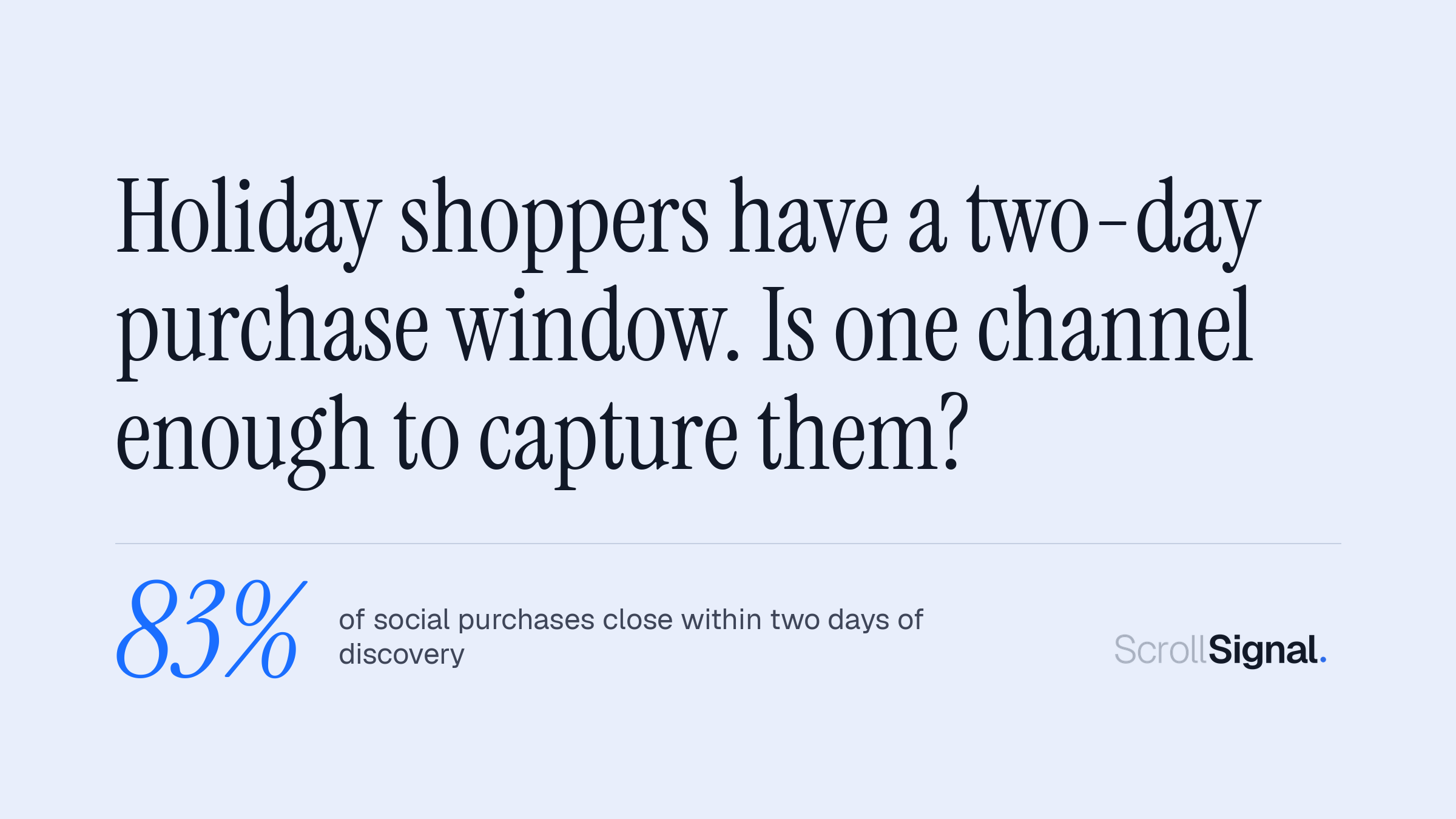
Most holiday shoppers on social media decide fast! 83% of social commerce purchases close within two days of the shopper first seeing the product, and the majority close within hours. Only 7% of buyers know exactly what they want before they see it. That's from our Social Commerce Intelligence Report 2026, a survey of 1,000 US social shoppers.
The purchase window is measured in hours, not days
The Social Commerce Intelligence Report 2026 asked 1,000 active social shoppers how long it took from first seeing a product to buying it. 83% purchased within two days, and almost a third of all purchases closed within minutes of first exposure. Most of the remaining volume closed within a few hours. Purchases that took longer than two days were the minority, not the norm.
That single number reframes how essential speed is for your holiday campaigns. A brand that reviews creative performance weekly, or tests a new offer over a five-day window, is measuring a decision that's already been made.
Why social commerce runs on impulse, not intent
Speed and spontaneity are connected. 73% of social commerce purchases start as unplanned or casual browsing. The shopper wasn't shopping for the product, or wasn't shopping for that specific one, when they saw it. Only 7% of buyers knew the exact product they wanted before they encountered it on social media.
That's the opposite of how most digital marketing playbooks are built. Search marketing captures demand that already exists: someone types a query because they already decided to buy something. Social commerce accelerates the decision in real time. The consumer isn't comparing options against an established checklist. They're reacting to what's in front of them, and reacting fast.
What this means for your Q4 playbook: the single-unit funnel
This data requires two foundational shifts in holiday planning.
1. Collapse your funnel into the first exposure. Traditional playbooks rely on a phased sequence: top-of-funnel creative on Day 1, consideration retargeting on Day 4, and conversion and trust ads on Day 7. When 83% of purchases close within 48 hours, that sequence is obsolete before it starts. The impulse buyer will never see your retargeted review ad or your return policy campaign. Every top-of-funnel creative unit must function as a self-contained funnel: hook, demonstration, customer ratings, and fulfillment guarantees embedded into the initial touchpoint.
2. Optimize for friction removal, not extended nurturing. Because social buyers act spontaneously, any uncertainty kills the sale. If an impulse buyer has to navigate away from the post to find sizing charts, return policies, or holiday delivery cutoffs, the decision window slams shut. Embed verified badges, clear return terms, and guaranteed delivery deadlines directly on the ad unit and the immediate landing screen.
Frequently asked questions
How fast do social commerce purchases happen?
According to the Social Commerce Intelligence Report 2026, 83% of social commerce purchases close within two days of the shopper first seeing the product, and almost a third close within minutes of first contact.
Are most social commerce purchases planned in advance?
No. 73% of social commerce purchases start as unplanned or casual browsing, and only 7% of buyers know the exact product they want before they see it on social media.
The full impulse-window data, including breakdown by age, platform, and category, is in the Social Commerce Intelligence Report 2026. The free executive summary covers the headline findings. The full report (PDF) is available at three license tiers.
ScrollSignal is an independent B2B research firm publishing original consumer research on social commerce. No platform funding. No sponsored findings. Just the data.