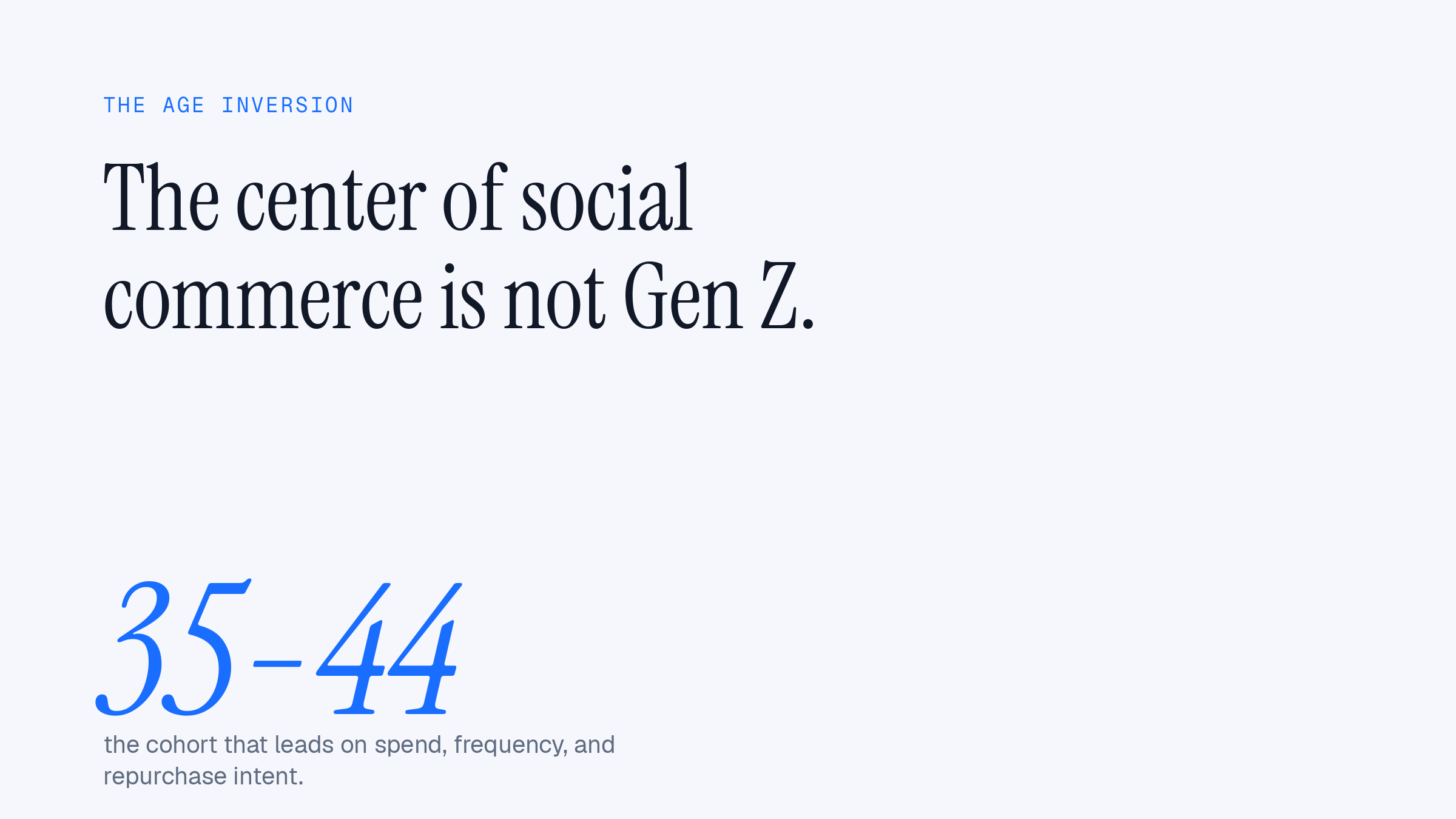
The cohort everyone targets is the least satisfied. The cohort everyone ignores is quietly doing the buying.
Ask most teams who social commerce is for, and you will hear a version of the same answer: young people. Gen Z lives on TikTok, the thinking goes, so that is where the social shopper is. Build for them, message to them, and the rest follows.
Our data says look again.
We surveyed 1,000 US social shoppers, stratified to Census on age, gender, and region. On every commercial metric we measured, frequency of purchase, total spend, and intent to buy again, the cohort that leads is not Gen Z. It is adults 35 to 44.
We call it the Age Inversion, and it reorders who you should be building for.
What the research found
The 35 to 44 cohort is not just spending more. They are having a better experience while they do it.
Put numbers on the spending. 54 percent of 35 to 44 shoppers spend $200 or more over six months, and 7 percent of them spend $1,000 or more, versus 1 percent of 18 to 24 year olds. The buying power sits squarely in the cohort the category treats as secondary.
Start with satisfaction. Shoppers aged 18 to 24 report the highest rate of bad purchases on social: nearly half of them have had a negative experience, compared with about a quarter of the 35 to 44 group. The youngest shoppers, the ones the industry optimizes hardest to reach, are the least happy with what they get.
Now put the two facts together. The cohort everyone targets is the least satisfied. The cohort everyone overlooks is the most commercially valuable, and the most likely to come back. That is the inversion: the spend and the loyalty sit a full decade older than the strategy.
Why this matters for your strategy
This is not a reason to abandon young audiences. It is a reason to be honest about what each cohort is worth, and to stop pouring your best budget into the group that converts least and complains most.
Targeting. If your personas, your creative, and your platform mix are all built around an 18 to 24 archetype, you are optimizing for reach into the least satisfied, lowest-spending cohort. The buyer with the wallet is being treated as an afterthought.
Creative and tone. Marketing built to feel native to a nineteen-year-old often reads as trying-too-hard to a forty-year-old parent who is, in fact, the one buying. The voice that converts the valuable cohort is not the voice most social playbooks default to.
Retention. The older cohort does not just spend more once, they intend to buy again. That makes them the cheaper, more durable growth engine. Acquisition-heavy strategies aimed at young churny audiences are the expensive way to grow.
What to do about it
One reframe: build for the buyer you have, not the buyer the category talks about.
Look at your own social commerce data by age before you set next quarter's targeting. If your spend and repurchase curves peak around 35 to 44, like ours do across the market, your media plan and your creative should peak there too. The Gen Z reach goal can stay, but it should be sized as what it is: top-of-funnel awareness into a less satisfied group, not the core of your commercial strategy.
If your social commerce plan is built on reaching Gen Z, you are optimizing for the wrong decade.
The full data, including spend and repurchase curves by cohort and cross-tabs by age, gender, income, and category, is in the Social Commerce Intelligence Report 2026. The free executive summary covers the headline findings. The full report (PDF) is available at three license tiers.
ScrollSignal is an independent B2B research firm publishing original consumer research on social commerce. No platform funding. No sponsored findings. Just the data.