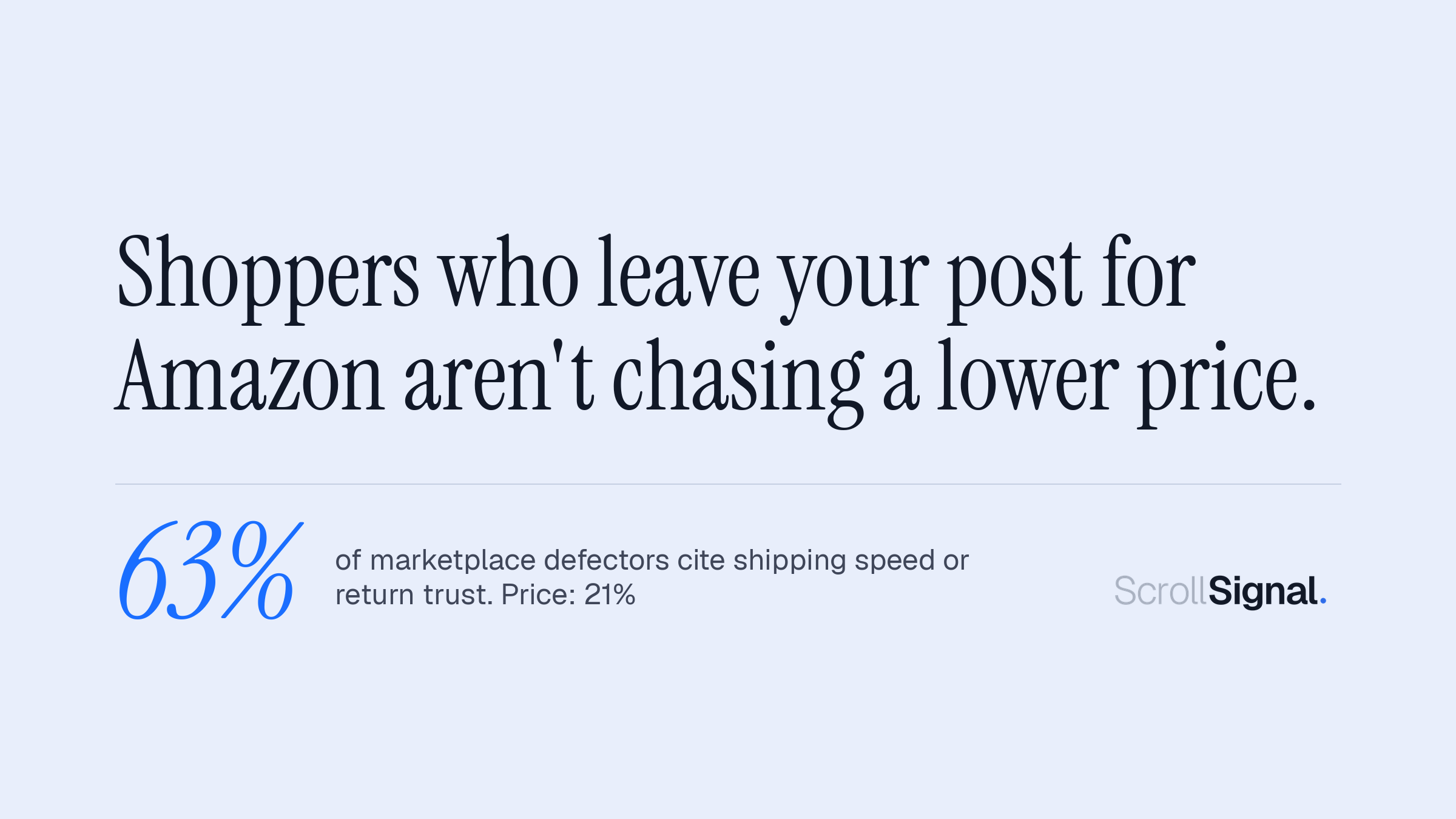
When social commerce shoppers abandon a brand's post to checkout on Amazon or another marketplace, price isn't usually the reason. Shipping speed and trust in the return-policy together account for 63% of the stated reason, per the Social Commerce Intelligence Report 2026, compared to just 21% for price.
What actually drives marketplace defection
Every brand selling on social loses some share of buyers to Amazon or another marketplace at the moment of purchase. The instinct is to read that as a price problem, assume the marketplace won on cost, and start discounting to compete. The Social Commerce Intelligence Report 2026 says that instinct is wrong.
Among shoppers who saw a product on social media and then defected to a marketplace to complete the purchase, shipping speed and return-policy trust together account for 63% of the stated reason, roughly three times the next factor, which is price at only 21%. Buyers aren't leaving because you're too expensive. They're leaving because Amazon has convinced them the package will arrive quickly and the return will be painless, and your checkout hasn't made the same case.
Why this is an operations problem, not a pricing problem
This is a fixable problem, and it's not a pricing problem. It's an operations-and-messaging problem: how fast can you actually ship, and does your checkout say so clearly, at the moment the shopper is deciding where to complete the purchase? A return policy that's generous but buried three clicks deep isn't doing the work it needs to do at checkout.
For context, in-app checkout and brand-site checkout together already account for roughly 84% of social commerce purchases, with marketplaces taking around 12%. That 12% is a leak worth closing, and it responds to fulfillment messaging, not markdowns.
How to audit your own checkout leak before the holiday surge
Before the holiday surge hits, pull your own numbers: what share of your social-acquired traffic actually checks out on your site or in-app, versus clicking through and finishing on a marketplace instead? Most brands don't know this number. It's worth finding out before assuming a marketplace leak is a pricing problem you need to discount your way out of.
Frequently asked questions
Why do social commerce shoppers switch to Amazon instead of buying directly?
Mostly due to trust in fulfillment, not price. 63% of shoppers who defect to a marketplace cite shipping speed or return-policy trust as the reason, versus 21% citing a lower price, per the Social Commerce Intelligence Report 2026.
What share of social commerce purchases finish outside the brand's own checkout?
About 12% finish on a marketplace like Amazon. In-app and brand-site checkout together account for roughly 84% of purchases.
Should brands discount to stop social shoppers leaving for Amazon?
Discounting targets the smaller reason. Price drives 21% of marketplace defection, while shipping speed and return-policy trust drive 63%, per the Social Commerce Intelligence Report 2026. Clear shipping and return terms at checkout address the larger share.
Full checkout-routing data, including in-app, brand site, and marketplace splits and what drives each, is in the Social Commerce Intelligence Report 2026. The free executive summary covers the headline findings. The full report (PDF) is available at three license tiers.
ScrollSignal is an independent B2B research firm publishing original consumer research on social commerce. No platform funding. No sponsored findings. Just the data.